Ask your question






Southern Europe
Montenegro
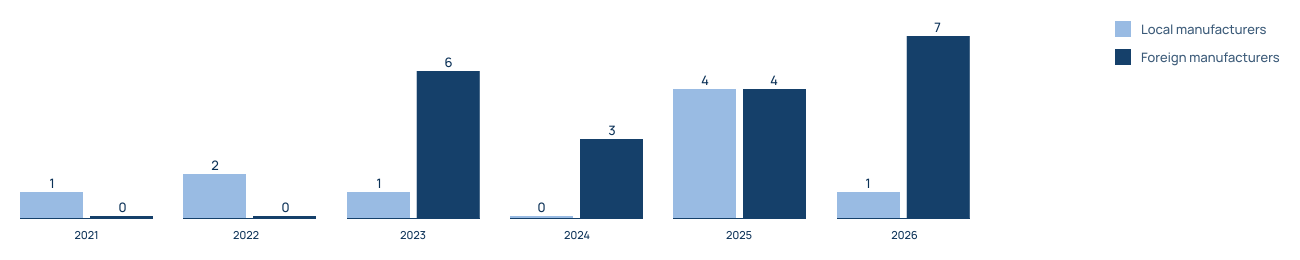
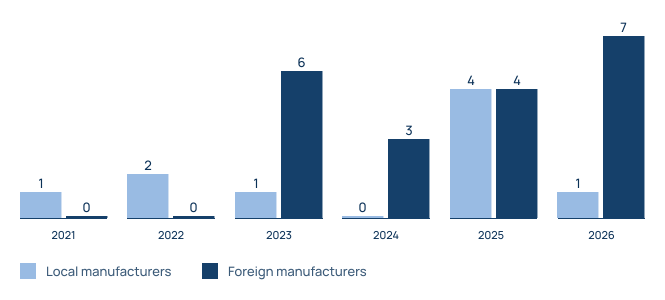
Number of inspections carried out
Deficiencies
The ten most common types of deficiencies over the entire period
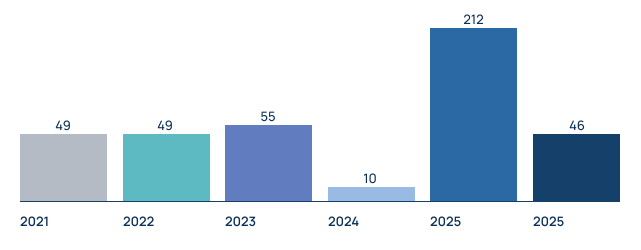
Number of deficiencies
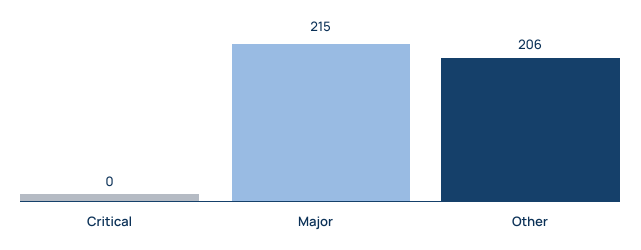
Number of deficiencies by category

Includes: incompletely filled log books (missing time, signature, date), obsolete versions of instructions in use, discrepancies between procedures and actual practice, incorrectly referenced documents, and inconsistent terminology.
Job descriptions of Qualified Persons (QP) do not reflect actual responsibilities; clear authority and independence in decision-making are lacking; GMP training is not conducted adequately; training records are incomplete or missing for certain employees.
Change controls do not include an evaluation of the impact on risk analyses, aseptic process simulations, or cleaning validations; regulatory impact is noted but implementation is not aligned with the assessment; changes are initiated retrospectively.
Status labels are missing on equipment and materials; premises are not adequately maintained; continuous monitoring of environmental conditions (temperature, humidity, particles) is not performed or measurements are taken infrequently; alarm systems are not established or alarms are not acted upon.
Validation protocols do not cover all formats or worst-case scenarios; APS (aseptic process simulation) do not cover the longest filling duration; sampling locations in working instructions do not correspond to those in the validation report. Equipment qualification is not performed at prescribed intervals.
Audit trails are not reviewed; back-up is performed inadequately (data modifiable, inappropriate frequency); data access is not adequately controlled (administrative roles assigned to unauthorised personnel); systems are not validated or validation is incomplete.
Quality agreements do not contain all GMP requirements: prohibition of sub-contracting without the contract giver's approval is missing; the division of QP responsibilities is not clearly defined; the contract acceptor does not have defined access to documentation; agreements are not signed by the QP.
Gowning is performed on the "less clean" side of the bench or before hand washing; the sanitisation procedure is not properly defined in the instructions; health examination records are incomplete.
The effectiveness of CAPA measures is not monitored; deadlines are exceeded without initiating deviations; the periodic quality management review is not conducted in accordance with the procedure or does not contain all prescribed elements (e.g. CCS review); the deviation management process is not recognised in practice.
Visual inspection is not performed under controlled conditions; a defect library has not been established; operator qualification has not been carried out; defect types are not trended.
Number of inspections carried out


Public register of GMP Certificates:
The register is updated in accordance with amendments of its content (last update 08.05.2026)
The register is updated in accordance with amendments of its content (last update 16.04.2026)
Bosnia and Herzegovina

Links to regulatory data
North Macedonia

Links to regulatory data
Serbia

Links to regulatory data